By Sam Franks
BELLEVILLE – Originally the land of the Mississaugas of the Credit, now the home of the Mohawks of the Bay of Quinte (KENHTÈ:KE KANYEN’KEHÁ:KA) misunderstanding and mistrust lead to the displacement of thousands.
The Mississaugas of the Credit were the original inhabitants of current-day Belleville, Ont.
The Mississaugas are group of Ojibwe (Anishinaabe) First Nation.
Just under 1,000 members currently reside in Hagersville, Ont. Adjacent to the Six Nations. There are over 2,700 Mississauga members in total.
Once stewards of over 4,000,000 acres of land bordering Lake Ontario and the “Golden Horseshoe”, after misleading and shady treaty deals now have only 6,000 acres to call home.
The Mississaugas are traditionally known for being incredible fishers, and being people of the water. They migrated along Lake Ontario based on migratory and fishing patterns.
The Royal Proclamation of 1763, made it so that only the Crown could buy land from First Nations’.
There were eight treaties that the Mississaugas were involved in, whether they knew it or not.
One of the most appalling treaties is the Toronto Purchase, 1787, where what we know as Toronto was bought for under $10,000 and with the understanding it was shared land.
The Treaty of Paris, 1763, affected all Indigenous communities who believed the word of the British when helping fight The Seven Years’ War. France surrendered its land to the British, who then gave the land to the American rebels they were fighting years later in the American Revolution.
This displaced thousands of Indigenous peoples.
Mohawks were displaced to Quebec area and current day Belleville. The Mississaugas welcomed the Mohawks upon arrival.
The Mohawks arrived on canoe on what is now called Airport Rd. There is a yearly celebration.
The Mississaugas surrendered this portion of the land in the Gunshot Treaty, 1788.
A monument of the treaty can be seen in Carrying Place.
Not all of the chiefs were present for the treaty.
The boundaries of land were established by how far the shot of a gun could be heard from the shore of Lake Ontario.
In 2015, the Rouge Tract land claim was submitted but hasn’t received answers.
The Mississaugas were not included in the Williams Treaty, 1923, which was the last treaty of significant land surrender. The Mississaugas never intended to surrender their land on the Red River Valley, which spans through Manitoba and parts of the United States of America.
Colonization caused over half of the Mississaugas population to decrease, from over 500 people to 200.
Maanjidowin: The Gathering is a statue that recognizes the Mississaugas of the Credit First Nation, located at the Billy Bishop Toronto City Airport.
The sculpture was created by Ohsweken born, Indigenous artist, David M. General and symbolizes the relationship between the Mississauga’s and the natural elements.
Present day, the Mohawks of the Bay of Quinte still reside in the area which they were greeted by the Mississaugas approximately on May 22, 1784.
The Mohawks were displaced from current day New York State, around Albany after the American Revolution.
The Simcoe Deed, or Treaty 3 and a half, was signed in 1793 after nine years of negotiations.
Land boundaries were unclear, however Mohawk people got way less than what was promised. Fishing and hunting were never included in the treaty as this was done orally.
Today, the Bay of Quinte Mohawks have stewardship of approximately 18,000 acres, and there are over 8,000 members.
After 14 years of being under a boil water advisory, over three quarters of the homes in Tyendinaga had access to safe drinking water. This was announced in 2022.
Which was always shocking considering less than 20-kilometres away the City of Belleville had clean water.
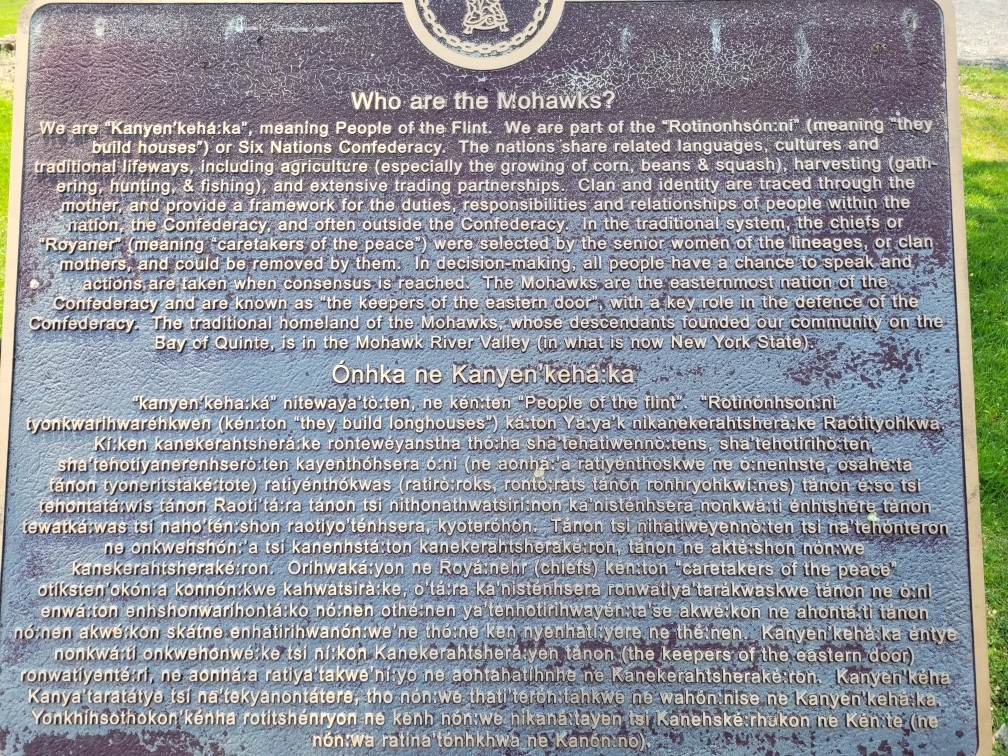
The Mohawks are apart of the Iroquois Confederacy.
The Iroquois Confederacy includes the Mohawks, the Oneida, the Cayuga, the Seneca and the Onondaga. Adding the Tuscarora in 1722.
The Iroquois Confederacy was established after the Great Peacemaker and Hiawatha travelled long and far across the lands spreading the message of peace and love.
The Nations within the Iroquois Confederacy are also referred to as Haudenosaunee meaning “people of the longhouse”.
Hiawatha and Peacemaker built the longhouse for all the Nations to sit and meet together.
The people did not believe The Great Peacemaker at first. He was tested to climb a tree and if he survives the fall, he must be who he says he is. The tree was cut down and the next day Peacemaker appeared.
The Nations joined together to set out for Hiawatha’s chief – who had snakes for hair. Hiawatha forgave the chief and combed the snakes out of his hair.
The White Tree of Peace was planted to remind everyone of the message The Peacemaker and Hiawatha spread.
The Mohawk flag colours are derived from the Two Row Wampum Belt which was given to British settlers to show harmony in different lifestyles. But it wasn’t a tangible thing, but an ethical concept which is foreign to the Eurocentric mind.
The white to symbolize peace and something good, the purple to represent civic affairs and mutual respect.
The Eagle is symbolic of the Peacemaker and will warn the Haudenosaunee Peoples if there is something bad or danger coming.
The Chain represents the ongoing need for communication between Haudenosaunee Peoples and the Europeans and the now established government system to address the systemic issues.
The Circle is for unity and to always have the back of another Nation.
A building of great historic significance is Her Majesty’s Royal Chapel of the Mohawks on Old Hwy. 2, it was built in 1843.
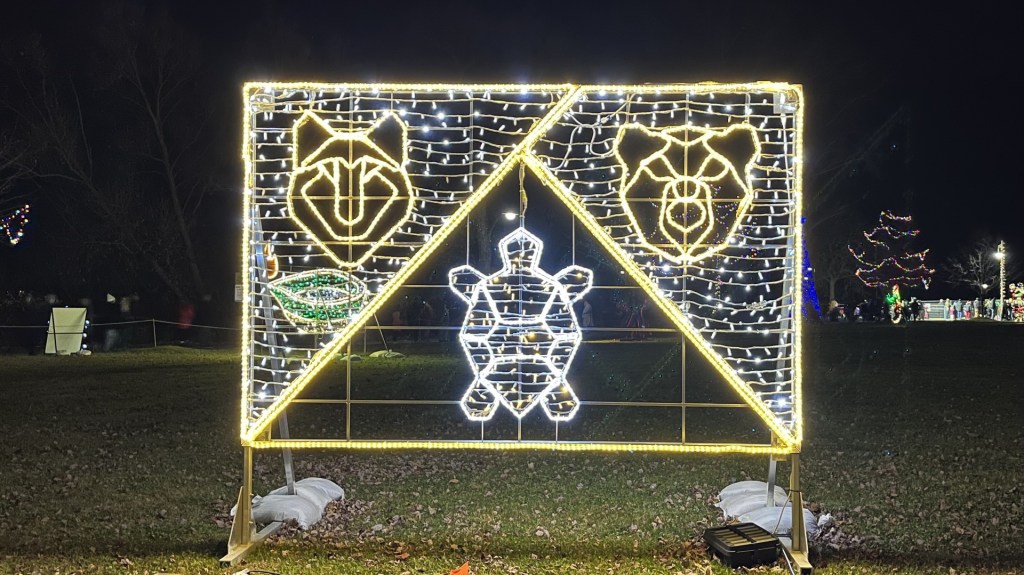
One of the most important stories is the creation story when a mystical Skywoman came down from another world and landed on a turtles back.
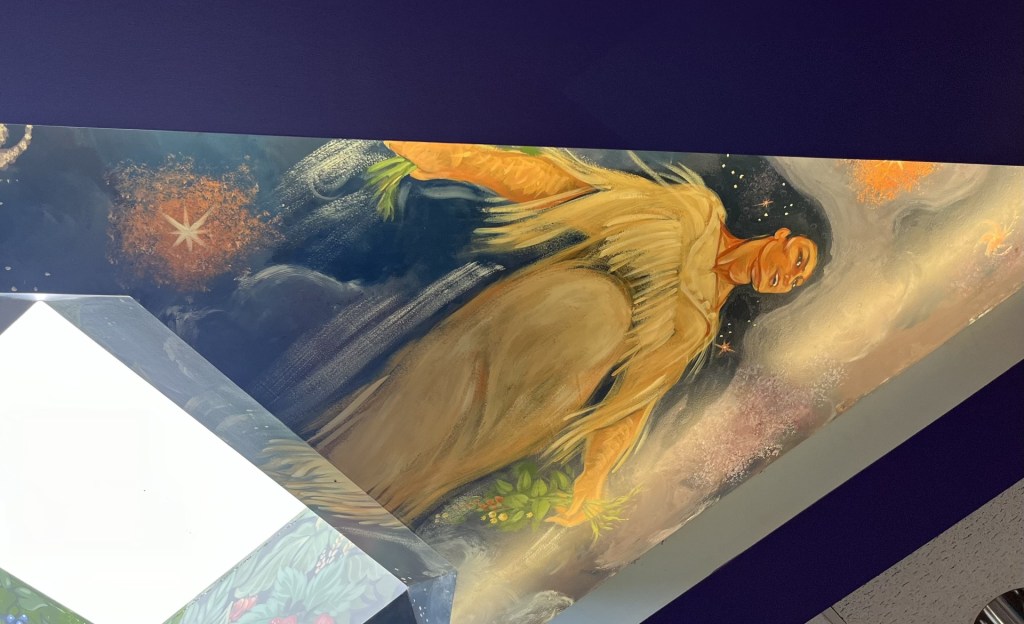
She had a pouch with a seed in it.
Many animals tried to swim to the bottom of the sea to get soil for Skywoman.
A muskrat was successful.
She walked counter-clockwise around the turtles back creating Turtle Island.
This is why Haudenosaunee peoples dance counter-clockwise, in respect to life and the Skywoman.
Women are traditionally held in high respects in Indigenous culture.
There has been a long history of displacement within all Indigenous communities.


Leave a Reply