By Sam Franks
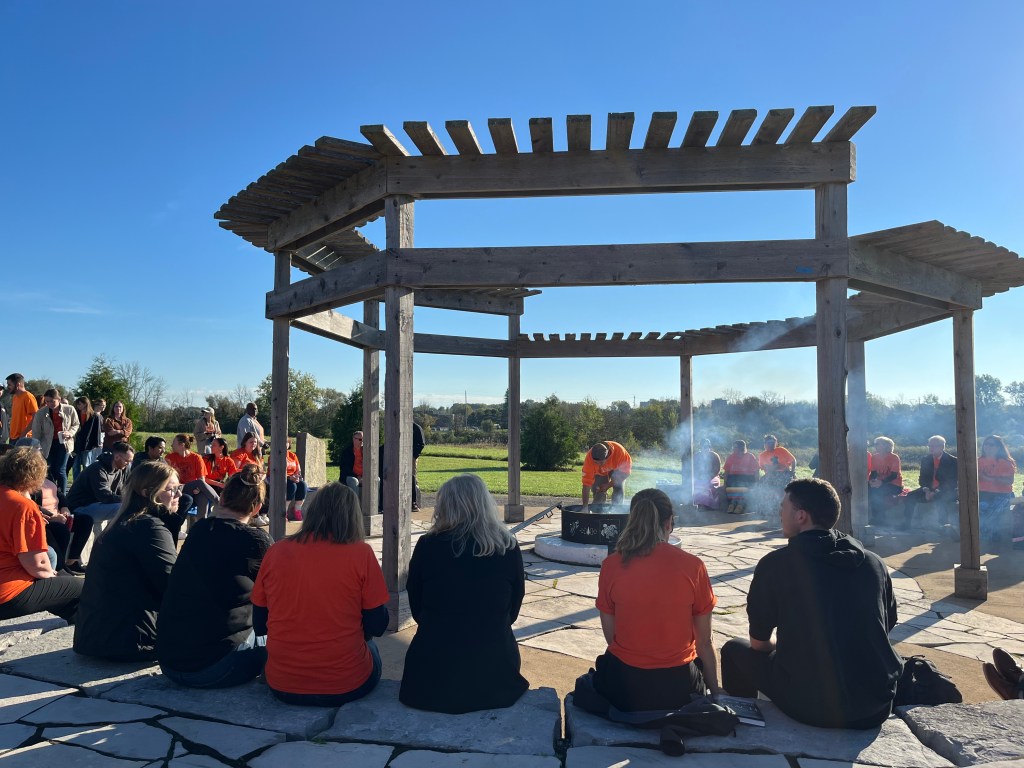
BELLEVILLE – The closing ceremony for Truth and Reconciliation Week attracted hundreds to the Anó:wara Learning Circle at Loyalist College to reflect on the past seven days.
The opening ceremony that marked the beginning of Truth and Reconciliation Week occurred on Sept. 24 and attracted a similar crowd.
The ceremony was led by Jennifer Tewathahá:kwa Maracle, executive director of Indigenous initiatives and reconciliation at Loyalist.
Maracle thanked students and staff for participating in the ceremony.
She explained that the week started solemnly to think about the children that attended residential schools.
“We took the time to put our intentions in that tobacco to grieve for the children who didn’t come home and for the children who came home but were forever altered,” Maracle told the crowd.
The Truth and Reconciliation Commission estimates more than 150,000 Indigenous children attended residential schools from 1831 and 1996.
Residential schools became mandatory for status children under the Indian Act in 1920.
Maracle reminded attendees of Indigenous resilience and the Canadian commitment to continue action.
“This is not just a one day a year where we put on our orange shirts, but this is a commitment that we make as Canadians to do something to change our direction,” Maracle said to the crowd.
Maracle introduced Indigenous Elder Helena Neveu to play two traditional songs.
One was to honour the children and the other for the round-dance.
“This is kind of funny [the round-dance] is something we have a joke around in the centre, for Haudenosaunee people – we dance counter-clockwise, and that means that we’re dancing for life, for the living. But Anishinabek people we say dance backwards, because they dance clockwise – to us that’s dancing for the dead, and we only do that once in one song. So, we’re always joking about which way is the wrong way – for the record it’s the Anishinabek way that’s wrong. It’s just a solidarity basically,” Maracle joked while explaining the meaning of the round-dance.
The participants of the closing ceremony joined hand-in-hand and danced clockwise in a giant circle while Neveu pounded the drum. Participants also partnered up to hold their hands in a pyramid while the line danced through.
When the song was over, attendees gathered back to the circle and Maracle recited the Ohén:ton Karihwatéhkwen.
The ceremony ended on a lighter note but the message Maracle conveyed was not lost among students of Loyalist like MacKenna Stein.
“I recently just got my Status Card, I’m Ojibway, so seeing this was just very cool. I’ve never been to anything like this so it was very inspirational,” Stein said.
Stein said that she loved the dancing and hearing an Indigenous language.
“My great-grandma she speaks Ojibway but she kind of lost it as she got older so I wasn’t around a whole bunch of cultural aspects in that way,” Stein explained.
According to a study from the Psychology of Communication, language plays a major role in cultural development.
Stein wasn’t the only student who was intrigued to hear an Indigenous language. Ayva Verburg is another student at Loyalist who expressed an interest in language.
“I want to learn more. I actually am thinking of learning Ojibway – I don’t know how I would do that, but of course, like I told you before my boyfriend is Ojibway so it would be really cool to learn the language,” Verburg told QNetNews.
Verburg walked away from the event feeling emotionally moved.
“I can’t imagine what they went through and it’s unspeakable really – what they went through. So, that touches my heart even though I’m not part of that [Indigenous community], it touches my heart a lot,” Verburg said.
Physiotherapy student Katie (who did not want to provide her last name) also felt sorrow.
“I grew up on the Tyendinaga Mohawk reserve so I’ve just been reflecting a lot, and like my childhood and stuff like that, and just thinking about the terrible time that the native people went through and it’s nice that we’re finally recognizing you know all the horrible things that they went through in their lives and their grandparents or their parents. We’re understanding the trauma that they went through, intergenerational traumas. It’s a really special week.” Katie said.
The week had a similar feeling for child and youth care student Emaan (who did not want to provide her last name).
“To me I feel that truth and reconciliation is an awareness that is being spread across and it reminds us all where we belong and who we belong to living on Canada, it’s Turtle Island,” Emaan said.
The crowd was encouraged to think of ways they can include reconciliation into their lives.
“I think just being more aware and I think more education. I think it’s really nice that we have the general education now that has the Indigenous parts in it and things like that. Just having more education. There’s evidence, being more inclusive about you know what’s really happened and not living in denial anymore.” Katie explained when being asked on how to further bring reconciliation.
On Sept. 26 NDP MP Leah Gazan (Winnipeg Centre) tabled a private bill to criminalize residential school deniers.
The bill is aimed to help protect survivors and family members of First Nations, Métis, and Inuit from further harm.
If the bill is passed it would be added to the Criminal Code of Canada.


Leave a Reply